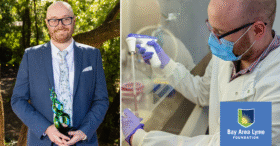
Bay Area Lyme Leading the Way series
“I wanted to be doing work that was driven by clinical need… and there are a lot of clinical needs in Lyme disease.”
– Peter Gwynne, PhD
 For too many people with Lyme disease, the journey begins with uncertainty. A missed rash. A negative test. Symptoms that don’t make sense. A diagnosis that comes too late, or not at all. Bay Area Lyme Foundation believes this must change. And we believe change happens through funding rigorous science, innovative thinking, and supporting researchers willing to tackle the hardest questions head-on.
One of those scientists is Tufts researcher Peter Gwynne, PhD, a microbiologist whose work sits at the cutting edge of Lyme research and is the recipient of our 2022 Emerging Leader Award. We spoke with Dr. Gwynne to get an inside look at his work and understand how this may impact Lyme patients in the future. His focus is simple to state but complex to achieve: develop better diagnostics, identify meaningful biomarkers, and move the field toward treatments and even prevention strategies that could fundamentally reshape how Lyme disease is understood and managed.
Drawn to Lyme by the Urgency of the Need
Dr. Gwynne did not begin his career in Lyme disease. He trained in molecular microbiology, studying pathogens such as Salmonella and Staphylococcus, the bacteria responsible for serious infections, including those often acquired in hospital settings. But over time, he found himself seeking work that could make a tangible difference for patients.
Lyme disease stood out for all the wrong reasons: widespread prevalence, persistent controversy, inadequate diagnostics, and far too many patients falling through the cracks. It was a field with profound unmet clinical need and enormous potential for impact. But something drew him to the field. “I wanted to be doing work that was driven by clinical need… and there are a lot of clinical needs in Lyme disease. That means there’s real potential to make an impact,” he noted. That combination ultimately led him to focus his research on Lyme and its long-term consequences.
 Meaningful Progress on Detecting Early Lyme
One of the most urgent problems in Lyme care is the lack of reliable early testing. Current blood tests rely on detecting antibodies, which take time to develop after infection. That means many patients test negative during the critical early window when treatment is most effective.
Working with collaborators and using well-characterized patient samples, Dr. Gwynne has helped evaluate a new diagnostic approach designed to detect infection earlier than existing tests. The findings underscore both the challenge and the opportunity. He explains: “In the first week of infection, the existing tests detected about 5–10% of cases. That’s functionally useless. The newer test detected about 30%.”
Thirty percent is not yet where we need the field to be. But it represents meaningful progress and, importantly, proof that earlier detection is possible. Each improvement in sensitivity means more patients diagnosed promptly, more people receiving timely treatment, and fewer individuals progressing to more complex, chronic illnesses.
“In the first week of infection, the existing tests detected about 5–10% of cases. That’s functionally useless. The newer test detected about 30%.” – Peter Gwynne, PhD
At Bay Area Lyme, we know that better diagnostics are the foundation of better outcomes, and research like this moves the field closer to that goal. Dr. Gwynne states the research obstacle succinctly: “You can’t do good studies if you don’t know who actually has the disease. The first domino that has to fall is a diagnostic test.”
He outlines the problem by explaining that once we have accurate diagnostics for all stages of Lyme, we will be able to have cohorts of patients who can participate in clinical trials that will show what therapies are effective at targeting which groups of symptoms. He frames the current challenge: “It’s a catch-22. You can’t study Post-Treatment Lyme Disease (PTLD) properly because you don’t actually know who has PTLD, and that makes it incredibly hard to develop treatments.”
 Biomarkers Could Transform Lyme Research and Care
One of the greatest barriers to progress in Lyme disease is the absence of reliable biomarkers, the biological signals that can clearly identify who has active disease, who is recovering, and who is experiencing persistent illness after treatment.
Post-Treatment Lyme Disease often overlaps with other conditions such as chronic fatigue syndrome, autoimmune disorders, and chronic pain syndromes. Without objective biological markers, it becomes extraordinarily difficult to design clinical trials, evaluate therapies, or even ensure that patients are being accurately diagnosed.
Dr. Gwynne’s work is increasingly focused on the immune system, particularly on identifying antibodies that may reflect ongoing disease processes rather than simply past exposure. In other illnesses, including multiple sclerosis, certain antibodies correlate with symptom severity and disease flares. His lab is exploring whether similar immune signatures exist in Lyme patients.
If successful, this work could help lay the groundwork for:
- Objective tools to diagnose Post-Treatment Lyme Disease (PTLD)
- Better ways to distinguish Lyme-related illness from overlapping conditions
- Biomarkers that track disease activity over time
- Stronger foundations for clinical trials and treatment development
For patients who have long been told that their symptoms are “subjective” or difficult to measure, this kind of progress is profoundly meaningful.
Smarter Treatments to Target Borrelia?
In parallel with his work on diagnostics, Dr. Gwynne is also tackling another major challenge: treatment specificity.

He notes that most antibiotics currently used for Lyme are broad-spectrum drugs. While often necessary and effective, they can disrupt the microbiome and carry side effects, especially when used over longer periods. The ideal future he paints is one in which treatments are precise: effective against Borrelia burgdorferi but gentle on the rest of the body. “The goal is to find drugs that kill Borrelia but don’t harm other bacteria. That would mean treatments that are more precise and potentially safer,” he explains.
“The goal is to find drugs that kill Borrelia but don’t harm other bacteria.” – Peter Gwynne, PhD
Using advanced computational methods, Dr. Gwynne analyzed the genome of Borrelia burgdorferi to identify biological processes that are essential to the bacterium but less common in other microbes. These processes represent potential drug targets.
His team then began testing existing compounds to see whether they could inhibit these targets. Several were able to kill Borrelia under laboratory conditions, an early but important proof of concept. While these compounds are not yet suitable as treatments, the findings provide a foundation for developing more refined, Lyme-specific therapies in the future.
This kind of work reflects a long-term vision: not just better treatment, but smarter treatment.
Rethinking What Lyme Prevention Could Look Like
Perhaps the most forward-looking aspect of Dr. Gwynne’s work is his interest in prevention. He points to models used in diseases like malaria, where people at high risk take targeted preventive medications during periods of exposure.
Imagine a future where outdoor workers, children in endemic areas, and others with frequent tick exposure could take a safe, highly targeted medication during peak tick season, and one that would neutralize Borrelia before infection could take hold. His team’s thinking is: “If you had a sufficiently narrow-spectrum drug, someone could take it through tick season. Even if the bacteria entered the bloodstream, they’d run straight into the drug and die.”
This idea remains aspirational, but it represents an important shift in how we think about Lyme disease: not only as a condition to diagnose and treat, but as one we might one day actively prevent.
 Building Scientific Lyme Infrastructure
For decades, Lyme research historically has been constrained by a lack of high-quality patient samples and long-term data. That is beginning to change, in large part thanks to Bay Area Lyme’s Lyme Disease Biobank. Clinical studies are also now enrolling patients at diagnosis and following them over time, collecting biological samples and tracking outcomes. How is this helpful? He notes that, “If we could find an antibody that’s present in most PTLD patients, it could be useful not only for diagnosis, but for understanding what’s actually happening biologically.”
“We’re finally getting the tools we need to do the work. I don’t think that was true twenty years ago.” – Peter Gwynne, PhD
Resources like Lyme Disease Biobank allow researchers like Dr. Gwynne to compare immune responses between patients who recover and those who develop persistent symptoms, an essential step toward identifying meaningful biomarkers and understanding disease mechanisms. It is the kind of infrastructure that strong science requires, and it is helping to move Lyme research from uncertainty toward clarity.

A Path Forward, Grounded in Science and Hope
Dr. Gwynne does not promise quick fixes. What he offers instead is something far more credible: thoughtful, rigorous science aimed directly at the problems patients care most about, which is diagnosis, validation, effective treatment, and prevention. “We’re finally getting the tools we need to do the work. I don’t think that was true twenty years ago,” he reflects.
Progress in biomedical research is rarely dramatic. It is incremental, built on careful work, validated findings, and collaboration. But progress is happening.
And with each advance in diagnostics, each new biomarker explored, each innovative approach to treatment, we move closer to a future where Lyme disease is easier to diagnose, simpler to treat, and far less likely to become chronic.
At Bay Area Lyme Foundation, that is the future we are working toward every day, and research like Dr. Gwynne’s brings it into clearer view.
Peter Gwynne, PhD, Post Doctoral Researcher, Tufts University, earned a BSc in Biochemistry from Cardiff University and a PhD in Molecular Microbiology from the University of Edinburgh. In Edinburgh, he completed two postdoctoral positions working between academia and industry, including developing antimicrobial medical devices to prevent hospital-acquired infections. His research focuses on developing novel technologies for the prevention, diagnosis, and treatment of bacterial infections. In 2018, he moved to Tufts University School of Medicine to study the metabolic adaptation of the Lyme disease bacterium B. burgdorferi to its human hosts. From this work, a series of antibodies was identified and found to be diagnostic for acute Lyme disease. His current project will use samples from Lyme Disease Biobank to test whether these antibodies could also be used to diagnose persistent symptoms of the disease. His diagnostic project was selected for the 2022 Emerging Leader Award, a $100,000 grant. Another project aimed at developing narrow-spectrum drugs targeting similar metabolic processes will begin this year, also funded by Bay Area Lyme Foundation.
This blog is part of our Bay Area Lyme Leading the Way series. If you require a copy of this article in a bigger typeface and/or double-spaced layout, contact us here. Bay Area Lyme Foundation provides reliable, fact-based information about Lyme and tick-borne diseases so that prevention and the importance of early treatment are common knowledge. For more information about Bay Area Lyme, including our research and prevention programs, go to www.bayarealyme.org.