“I wanted to be doing work that was driven by clinical need… and there are a lot of clinical needs in Lyme disease.”
– Peter Gwynne, PhD
For too many people with Lyme disease, the journey begins with uncertainty. A missed rash. A negative test. Symptoms that don’t make sense. A diagnosis that comes too late, or not at all. Bay Area Lyme Foundation believes this must change. And we believe change happens through funding rigorous science, innovative thinking, and supporting researchers willing to tackle the hardest questions head-on.
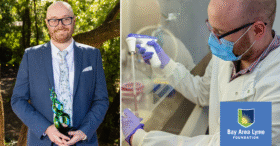
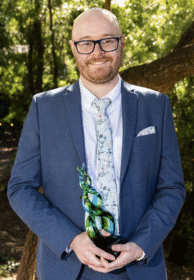
One of those scientists is Tufts researcher Peter Gwynne, PhD, a microbiologist whose work sits at the cutting edge of Lyme research and is the recipient of our 2022 Emerging Leader Award. We spoke with Dr. Gwynne to get an inside look at his work and understand how this may impact Lyme patients in the future. His focus is simple to state but complex to achieve: develop better diagnostics, identify meaningful biomarkers, and move the field toward treatments and even prevention strategies that could fundamentally reshape how Lyme disease is understood and managed.
Drawn to Lyme by the Urgency of the Need
Dr. Gwynne did not begin his career in Lyme disease. He trained in molecular microbiology, studying pathogens such as Salmonella and Staphylococcus, the bacteria responsible for serious infections, including those often acquired in hospital settings. But over time, he found himself seeking work that could make a tangible difference for patients.
10 Years of Collaboration Bringing Hope: How Dr. John Aucott’s Relationship with Bay Area Lyme Helped Get Groundbreaking Biobanks Launched to Fuel the Research Engine of Lyme Disease Investigations
In this blog, part of our 10-year anniversary blog series, we talk with John Aucott, MD, Associate Professor of Medicine at Johns Hopkins University, Director of the Lyme Disease Research Center, about his work and how his investigations are helping us understand persistent/chronic Lyme infections. A long-term collaborator and grant recipient of Bay Area Lyme Foundation, Dr. Aucott reflects on his history with our organization, the ongoing plight of Lyme disease patients, and the slow growth in government funding for investigations into the disease. He talks about the early days of identifying the need for well-characterized samples from Lyme patients and his role in helping launch biobank programs, including his own SLICE Study Biorepository and BAL’s Lyme Disease Biobank.
Bay Area Lyme: I want to take you right back to the very beginning of your relationship with Bay Area Lyme (BAL), the founding of your SLICE study and our Lyme Disease Biobank (LDB) and talk about everything that was happening 10 years ago. People talk about the “norming, storming and forming” stages of organizations, and there was an awful lot of activity going on 10 years ago in the world of Lyme disease. And so, please share your thoughts on what was happening around that time, your part in it, and how you came into the picture with BAL and our biobank.
The Study of Lyme disease Immunology and Clinical Events (SLICE), Johns Hopkins University Lyme Disease Research Center
John Aucott: My first memory is that I flew out to California and my agenda at that time was getting people interested in research. There was very little funding for Lyme disease research, and to some extent there still isn’t a great amount of funding for Lyme disease, especially the kind of research I do, which is clinical translational research. I’m an MD, so my research involves bridging basic science to human beings to patients. So, to be very candid about it, I was interested in getting BAL interested in my work. I pitched what we were doing. We had already set up the Johns Hopkins SLICE study, the Study of Lyme disease Immunology and Clinical Events. And at that point it was one of only two large scale biobanks collecting for Lyme disease. The other one is Dr. Gary Wormser’s, who still has a biobank in Valhalla, New York.
So, I was pitching the idea of a Lyme disease biobank to BAL, and this was a whole new concept. A biobank is a hard concept to sell initially because people don’t understand that setting up a biobank is like being Levi Strauss: It’s selling the Levis and the picks, and the shovels—not selling them the actual gold in your pocket. And it’s a hard pitch because people don’t understand that somebody has to supply the foundational work so that other people can mine for the gold. But BAL caught on to the idea that the biobank that we had at Hopkins was a crucial resource that would enable collaboration with other researchers to advance the scientific understanding of disease mechanisms and potentially identify and validate biomarkers for improving diagnostics and treatments.
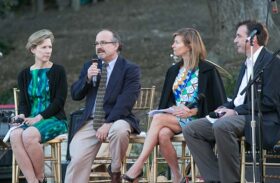
LymeAid 2014 Scientific Panel (from left): Wendy Adams, John Aucott, MD, Carin Rollins, and Bill Robinson, MD, PhD
Bay Area Lyme bought into the importance of this idea. The first thing that happened was you asked me to be on the BAL Scientific Advisory Board soon thereafter. BAL expressed support for the SLICE study’s biobank at Hopkins and you actually gave us one of our first grants to help support our biobank work. So, that was the first thing that happened. We applied for a grant, and we got a grant from BAL to help us because we had not yet gotten federal funding for it. So, that was one of the first grants to support it, and now in 2023 we are finally receiving our first NIH funding.
 For too many people with Lyme disease, the journey begins with uncertainty. A missed rash. A negative test. Symptoms that don’t make sense. A diagnosis that comes too late, or not at all. Bay Area Lyme Foundation believes this must change. And we believe change happens through funding rigorous science, innovative thinking, and supporting researchers willing to tackle the hardest questions head-on.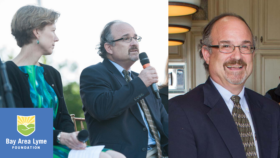
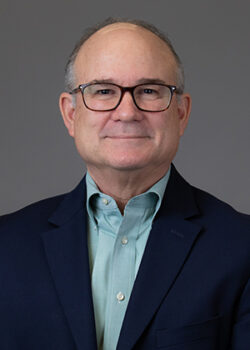 In this blog, part of our 10-year anniversary blog series, we talk with John Aucott, MD, Associate Professor of Medicine at Johns Hopkins University, Director of the Lyme Disease Research Center, about his work and how his investigations are helping us understand persistent/chronic Lyme infections. A long-term collaborator and grant recipient of Bay Area Lyme Foundation, Dr. Aucott reflects on his history with our organization, the ongoing plight of Lyme disease patients, and the slow growth in government funding for investigations into the disease. He talks about the early days of identifying the need for well-characterized samples from Lyme patients and his role in helping launch biobank programs, including his own SLICE Study Biorepository and BAL’s Lyme Disease Biobank.