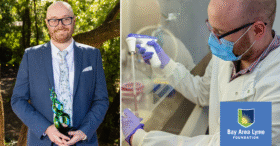
Improving Lyme Diagnostics, Biomarkers, and Treatment: Inside Dr. Peter Gwynne’s Research

Peter Gwynne, PhD

Bay Area Lyme Leading the Way series


“I wanted to be doing work that was driven by clinical need… and there are a lot of clinical needs in Lyme disease.”

– Peter Gwynne, PhD

Peter Gwynne, PhDFor too many people with Lyme disease, the journey begins with uncertainty. A missed rash. A negative test. Symptoms that don’t make sense. A diagnosis that comes too late, or not at all. Bay Area Lyme Foundation believes this must change. And we believe change happens through funding rigorous science, innovative thinking, and supporting researchers willing to tackle the hardest questions head-on.

One of those scientists is Tufts researcher Peter Gwynne, PhD, a microbiologist whose work sits at the cutting edge of Lyme research and is the recipient of our 2022 Emerging Leader Award. We spoke with Dr. Gwynne to get an inside look at his work and understand how this may impact Lyme patients in the future. His focus is simple to state but complex to achieve: develop better diagnostics, identify meaningful biomarkers, and move the field toward treatments and even prevention strategies that could fundamentally reshape how Lyme disease is understood and managed.

Drawn to Lyme by the Urgency of the Need

Dr. Gwynne did not begin his career in Lyme disease. He trained in molecular microbiology, studying pathogens such as Salmonella and Staphylococcus, the bacteria responsible for serious infections, including those often acquired in hospital settings. But over time, he found himself seeking work that could make a tangible difference for patients.
Bay Area Lyme Foundation ELA Winner Uses Metabolic Modeling to Predict 77 Unique Drug Targets in Lyme Disease Bacterium

Peter Gwynne, PhD

FOR IMMEDIATE RELEASE


Bay Area Lyme Foundation ELA Winner Uses Metabolic Modeling to Predict 77 Unique Drug Targets in Lyme Disease Bacterium

Results will help inform future research and development of new Lyme disease therapeutics

PORTOLA VALLEY, Calif., October 19, 2023—Bay Area Lyme Foundation, a leading sponsor of Lyme disease research in the US, today announced the findings of a study identifying new essential gene and enzyme drug targets in Lyme disease bacterium, which resulted, in-part, from a grant provided to Peter Gwynne, one of Bay Area Lyme Foundation’s 2022 Emerging Leader Award (ELA) winners. Published in the peer-reviewed journal mSystems, the study uses the most comprehensive metabolic modeling to date to predict 77 unique drug targets in Borrelia burgdorferi, the bacterium that causes Lyme disease—a condition affecting nearly 500,000 new patients annually.

“Lyme disease is often treated using long courses of antibiotics, which can cause side effects for patients and risks the evolution of antimicrobial resistance. Our research supplies the blueprint and scaffolding to build better Lyme disease therapeutics that do not have off-target effects for patients,” said Peter Gwynne, PhD, lead author on the study, research assistant professor at Tufts University School of Medicine, and Emerging Leader Award winner of the Bay Area Lyme Foundation. “Many of the 77 genes and enzymes predicted as essential represent candidate targets for the development of novel antiborrelial drug development.”

Current clinical guidelines recommend treatment of Lyme borreliosis with broad-spectrum antibiotics, which can pose risks to the patient’s microbiome. The bacterium that causes Lyme disease is extremely host-dependent, with a small genome and limited metabolism—making it an excellent candidate for the development of targeted, narrow-spectrum antimicrobials.

In the study, the researchers used in silico genome-scale metabolic computer modeling to construct a map of B. burgdorferi metabolism. This map was used to predict essential genes and enzymes that can be used as drug targets. Gwynne and the Tufts University School of Medicine research team validated these targets by repurposing existing drugs that kill B. burgdorferi in culture. While these drugs are not viable treatment options themselves, they provide a blueprint for future novel drug development.