American Ninja Warrior Elet Hall Educates about Lyme Disease Risks

FOR IMMEDIATE RELEASE

Media Contact:
Tara DiMilia, 908-947-0500, tara.dimilia@TMstrat.com

American Ninja Warrior Elet Hall Educates about Lyme Disease Risks

Growing issue of Lyme disease in California prompts Association for Environmental and Outdoor Education (AEOE) to provide Lyme education at statewide conference

Silicon Valley, CA, May 9, 2016 — Bay Area Lyme Foundation, a leading non-profit funder and advocate of innovative Lyme disease research in the US, today announced that Elet Hall, ambassador for the Bay Area Lyme Foundation, and Jo Ellis, director, education outreach, Bay Area Lyme Foundation helped raise awareness about Lyme disease and tick-borne illnesses among California Association for Environmental and Outdoor Education (AEOE) conference attendees.  Attendees included individuals who work in museums, zoos, nature centers, and state and national parks as well as environmental and outdoor educators who help instill an understanding of nature to individuals of all ages, from California and neighboring states.
Beware the Questing Tick!

May is Lyme Awareness month. And it is indeed time to be aware. Thanks to El Niño, it’s a wetter Spring than we’ve had in several years. That means we have lots of green grass, damp leaf litter, and overgrown trails and paths. It also means the ticks are out. And early spring means nymph season — these nymphs are young ticks, not much bigger than a poppy seed … the kind that are easy to miss with a quick glance.

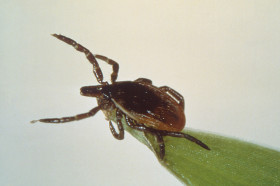
Anna Perez This photograph depicts a deer tick, or blacklegged tick, Ixodes scapularis, as it was questing on a blade of grass.The Lyme disease bacterium, Borrelia burgdorferi, is spread through the bite of infected ticks. The blacklegged tick (or deer tick, Ixodes scapularis) spreads the disease in the northeastern, mid-Atlantic, and north-central United States, and the western blacklegged tick, Ixodes pacificus, spreads the disease on the Pacific Coast. Ticks can attach to any part of the human body but are often found in hard-to-see areas such as the groin, armpits, and scalp. In most cases, the tick must be attached for 36-48 hours or more before the Lyme disease bacterium can be transmitted.Most humans are infected through the bites of immature ticks called nymphs. Nymphs are tiny (less than 2mm) and difficult to see; they feed during the spring and summer months. Adult ticks can also transmit Lyme disease bacteria, but they are much larger and may be more likely to be discovered and removed before they have had time to transmit the bacteria. Adult Ixodes ticks are most active during the cooler months of the year.
Adult Ixodes tick questing. Photo by Anna Perez, courtesy of CDC (Centers for Disease Control and Prevention)

The good news is that ticks can’t fly, jump, or even run. But they do “quest” — they hang out on leaves, blades of grass, and branches, tiny legs poised to grab onto a warm body passing by. Ticks need to feed in order to progress to the next life stage and perching ready to grab a free ride (and meal!) on an unwitting passerby is how they ensure their survival.

When hiking or biking in the woods, if you keep to the center of the trail and avoid bushwhacking and brushing up against high grasses or other vegetation, your risk of picking up a parasitic passenger is pretty low. Once you leave the trail for a pit stop, however, the risk rises exponentially. Ticks are carried by deer and other small mammals that also like to use the trails so the highest concentration of ticks is often close to trails.

Experts Hack for Lyme Disease Solutions in Boston and Berkeley

FOR IMMEDIATE RELEASE

Media Contact:
Tara DiMilia, 908-947-0500, tara.dimilia@TMstrat.com

Experts Hack for Lyme Disease Solutions in Boston and Berkeley

Bay Area Lyme Foundation Supports the First Hackathon for Lyme Disease to Inspire Innovation

Silicon Valley, CA, April 18, 2016— To inspire innovation to help solve the challenges of Lyme disease, Bay Area Lyme Foundation, collaborating with the Spaulding Rehabilitation Network’s Dean Center for Tick Borne Illness, Harvard Medical School Department of Physical Medicine and Rehabilitation, MIT Hacking Medicine, University of California, Berkeley, and the Veterans Affairs Center for Innovation, is supporting Lyme Innovation, the first ever Hackathon for Lyme disease, a potentially devastating condition newly infecting 329,000 people each year. Scientists, clinicians, researchers, entrepreneurs, and investors from both U.S. coasts participated in this innovative event, which kicked off this weekend, and will continue in Cambridge June 17 – 19, at the Microsoft Nerd Center.

Primary Care Medicine and the Challenges of Diagnosing Lyme Disease

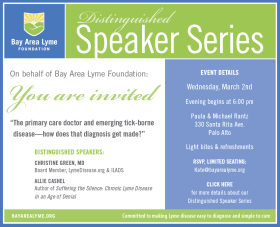
Bay-Area-Lyme-Foundation-Speaker-SeriesOn March 2nd, Bay Area Lyme again hosted another of its Speaker Series events. These popular salon-style events allow community members to come together in an intimate forum to share stories and hear directly from experts in the field.

The featured speakers this time were Dr. Christine Green, MD, a recognized leader in Lyme disease diagnosis and treatment and Allie Cashel, author of Suffering the Silence: Chronic Lyme Disease in an Age of Denial. Both shared personal and professional perspectives on the challenges of diagnosing Lyme disease. 

Lyme and Tick-Borne Disease in the US: Current State of Affairs

Dr. Ben Beard_CDCDr. Ben Beard, PhD, Chief Bacterial Diseases Branch at the CDC, visited with Bay Area Lyme and invited guests as part of the foundation’s ongoing speaker series. This donor-sponsored forum brings together researchers and other experts in an intimate forum for topical discussions with community members. Past events have included Emerging Leader Award winners, clinicians, and patient advocates.

The next event, on Wednesday, March 2, will feature Dr. Christine Green, Director of Education for ILADS, and Allie Cashel, author of Suffering the Silence: Chronic Lyme Disease in an Age of Denial.

For more information, see Speaker Series.

———————————————————————————————————-

As Chief of the CDC’s Bacterial Diseases Branch, Division of Vector-Borne Diseases in Fort Collins, Colorado, Dr. Beard coordinates CDC’s programs on Lyme disease, plague, and tularemia. His scientific interests include public health and the biology, ecology, and genetics of insect-borne diseases and vectors. More recently, he has been extensively involved in the CDC’s work to understand and mitigate the potential impact of climate variability and change on infectious disease ecology. He shared the CDC’s concerns about the expanding disease burden and distribution of Lyme and affirmed the importance of attracting new research interest and efforts focused on Lyme disease and other tick-borne infections.

Bay Area Lyme Foundation Offers Free Tick Testing Nationwide

FOR IMMEDIATE RELEASE

Media Contact:
Tara DiMilia, 908-947-0500, tara.dimilia@TMstrat.com

Bay Area Lyme Foundation Offers Free Tick Testing Nationwide

Free Tick Testing Initiative Is First In The Nation and Aims to Map Tick-borne Diseases Across the U.S. Through Crowd-sourcing

Silicon Valley, CA, February 16, 2016 — Bay Area Lyme Foundation, a leading nonprofit funder of innovative Lyme disease research in the US, today announced that the Foundation is the first to offer free tick testing for residents of the U.S.  Testing is available through a partnership with Nate Nieto, PhD, Assistant Professor, Department of Biological Sciences, Northern Arizona University and his lab.  Bay Area Lyme Foundation hopes to use this crowd-sourced data as a vehicle for gaining a greater understanding of the geography of tick-borne diseases in the U.S.  If successful in accumulating data, it will be the first crowd-sourced study of its kind.

Bay Area Lyme Foundation To Provide Tick and Lyme Disease Education in the Solano Resource Conservation District

FOR IMMEDIATE RELEASE

Media Contact:
Tara DiMilia, 908-947-0500, tara.dimilia@TMstrat.com


Bay Area Lyme Foundation To Provide Tick and Lyme Disease Education in the Solano Resource Conservation District

Program is open to the public and part of extensive education program throughout the Bay Area

Silicon Valley, California, October 26, 2015—The Bay Area Lyme Foundation, which aims to make Lyme disease easy to diagnose and simple to cure, will provide training about ticks and Lyme disease to naturalists, outdoor educators, program managers and the general public in the Solano Resource Conservation District, as well as other local agencies, to better educate area students, parents and classroom teachers. The program is part of an educational initiative started at Bay Area Lyme Foundation to inform California residents about prevention, the proper removal of ticks, and symptoms of tick-borne diseases.  It is based on new information that Lyme disease is endemic to the area.

Bay Area Lyme Foundation Announces Grant Application for Two $100,000 Awards for Lyme Disease Research

FOR IMMEDIATE RELEASE

Media Contact:
Tara DiMilia, 908-947-0500, tara.dimilia@TMstrat.com

Bay Area Lyme Foundation Announces Grant Application for Two $100,000 Awards for Lyme Disease Research

‘Emerging Leader Award’ aims to attract new scientific talent to address scientific challenges of Lyme disease

Silicon Valley, California, October 5, 2015—The Bay Area Lyme Foundation, a leading national funder of Lyme disease research in the US, today announced a call for applications for two $100,000 Bay Area Lyme Foundation ‘Emerging Leader Award’ grants.  These awards will be given to two promising scientists who embody the future of leadership in Lyme disease research in the US.  The award recipients will be researchers in academia or the private sector who are currently at the post-doctoral level through the assistant Professor level, or equivalent, who have identified a defined approach to improve diagnostics or therapies for Lyme disease. Important criteria include demonstrated professional and scientific leadership in the biomedical sciences and a strong supporting scientific rationale for the project.  Research efforts funded by the award are required to generate initial proof of concept within 12–18 months.

An Ounce of Prevention …Vaccinate your dogs!!

Dr Michael Sterns_headshot_156By Dr. Michael Sterns, DVM, Alta View Animal Hospital, Mountainview, CA

The following is a guest post from a local veterinarian and long-time SF Bay area resident, Dr. Michael Sterns, DVM. He shares a story about the recent diagnosis of a four-legged patient with Lyme disease. It is rare for the blood tests to come back definitive in dogs so this case is unusual but the lessons are clear and relevant for all dog owners here and around the country.

I thought people might be interested in a case we saw last week, and might truly see how an ounce of prevention really is worth a pound of cure! Lyme disease in your dog is so easily prevented here in the SF Bay area, this story will surely leave you scratching your head. Happily, the dog in question will be OK – all because we caught it so early.

Investigating and Living with the Elusive Culprit of Lyme Disease

Why is it that Lyme disease is so little understood, so hard to diagnose, and so frustratingly difficult to get treated? Such were the questions discussed last night at the first of the new Bay Area Lyme Foundation Speaker Series talks.

Field Mustard by Robert Buelteman

2014 Emerging Leader AwardJerome Bouquet recipient Jerome Bouquet, PhD, UCSF, began the program with a compelling overview of the history of Lyme disease and its pathology, highlighting some of the complicated attributes of the Lyme-causing spirochete and the manifestations of its infection. He touched on promising new technologies like the Tick Chip and the IBIS-developed Iridica, which use unbiased DNA amplification and multiplex assays with greater sensitivity (and more immediate results) than traditional methods. He also described promising developments in transcriptomics that have illustrated the lingering effects of the disease up to six months after treatment, and