New Study Reveals Ticks in Bay Area Carry Larger Diversity of Bacteria Than Expected and May Help Explain Why Lyme Disease Symptoms Vary Widely Among Bay Area Patients

FOR IMMEDIATE RELEASE

Media Contact:
Tara DiMilia, 908-947-0500, tara.dimilia@TMstrat.com

New Study Reveals Ticks in Bay Area Carry Larger Diversity of Bacteria Than Expected and May Help Explain Why Lyme Disease Symptoms Vary Widely Among Bay Area Patients

Rates of tick infection with Borrelia miyamotoi are found to be higher in the Bay Area than previously documented on East Coast, and Tick-borne disease infection risk is shown to be higher in Redwood habitats than previously believed

SILICON VALLEY, Calif., August 19, 2015 — Bay Area Lyme Foundation, which is working to make Lyme disease easy to diagnose and simple to cure, highlights a new Bay Area study  conducted by researchers from Stanford and Northern Arizona Universities documenting a vast diversity of bacterial species and strains that cause tick-borne diseases in Bay Area residents and visitors.  The variety of bacterial species and strains identified may be the reason that Bay Area patients with tick-borne diseases experience a wide range of symptoms, which may or may not include flu-like complaints, joint pain, fatigue and a rash of differing shapes, thereby making exact diagnoses extremely difficult.

Design for Good: Teaching Tick-Bite Prevention to School Children

As part of our education outreach, Bay Area Lyme identified a need for an interactive, informative, “nature-museum” style experience that would help teach children about Lyme disease.

Knowing that young people are often incredible problem solvers and innovators and eager to tap a community with direct empathy for our target market, we approached D-Tech High, a new charter school in Millbrae, with a design challenge. We asked the students to design an educational and engaging, self-contained, “children’s museum-like” experience to spread awareness about Lyme disease and provide children with tick-bite prevention tips.

Are the Deer to Blame?

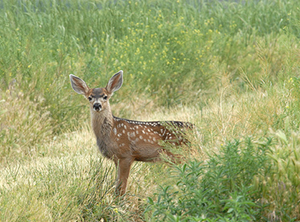
deer_300Blacklegged ticks, both the Western and Eastern varieties, are often known as “deer ticks” … Does that mean deer are to blame for the spread of Lyme disease?

Perhaps surprisingly, the answer is not obvious. While deer are a common host animal for the ticks (and can carry as many as 1000 ticks per animal!), they do not support the Lyme-causing spirochete (Borrelia burgdorferi bacteria). Ticks can feed, reside, and reproduce on deer but need to come into contact with the bacteria via another host before biting a human to spread Lyme disease. So, while there is a correlation between human Lyme cases and corresponding deer populations, it has more to do with the deer enabling the expansion of the tick population than the transmission of the bacteria. Mice and ground squirrels, both of which are common hosts for both ticks and the bacteria, are much more likely to bring infected ticks into human contact (…just in case you were looking for another reason to avoid rodents!)

There are a lot of intriguing facts and misperceptions about which animals do or don’t contribute to Lyme risk. And more research is being done to evaluate exactly which layers of the food chain have the greatest impact in the proliferation or containment of the ticks and the bacteria. Here’s what we know now…