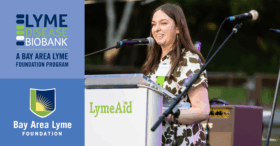
Bay Area Lyme Leading the Way Series
Guest blog by Lyme Advocate, Meghan Bradshaw, Government Relations Manager, Center for Lyme Action
“Bay Area Lyme Foundation’s leadership, fundraising, and commitment to research and patient advocacy have been a bedrock.”
– Meghan Bradshaw
When I look back over the past few years, I’m struck by how much has changed—for me personally, and for the broader Lyme and tick-borne disease community. And perhaps most of all, I see how partnership and persistence have turned what once felt impossible into genuine progress.
Turning Pain into Purpose as a Living Donor
One of the most powerful examples of Bay Area Lyme’s impact is Lyme Disease Biobank—a groundbreaking resource that provides researchers with high-quality, well-characterized samples to accelerate discoveries in diagnostics and treatment.
I know firsthand what it means to contribute to that effort—with my own body. As a living donor, I’ve donated multiple joints to the Biobank following joint replacement surgeries. It was, without exaggeration, a painful process. But I did it because I believe in turning my suffering into solutions—knowing that those tissues may one day help someone else get diagnosed sooner or treated more effectively.
“Every patient whose sample is stored in the Biobank could be the key that unlocks a treatment for someone else.”

These donations are more than scientific samples—they represent hope and progress. I encourage others to consider participating as living donors by providing blood or tissue samples, or as post-mortem donors, to help researchers better understand these complex illnesses. Every contribution helps fill critical knowledge gaps and moves us closer to breakthroughs.
At Bay Area Lyme’s LymeAid® 2023 event, I shared my story publicly for the first time—how I’d gone from being bedridden to walking again, from pain to purpose. That night, surrounded by scientists, donors, and fellow advocates, I realized just how powerfully personal stories can drive collective action.
Today, as I look at the advances in diagnostics and early detection coming from research supported by Bay Area Lyme and powered by Biobank samples, I feel immense gratitude. This is what it means to make pain matter.
Bay Area Lyme: A Foundation for Change
From the start, the Bay Area Lyme Foundation has been more than a supporter—it has been a true architect of change for the Lyme patient community. Bay Area Lyme’s leadership, fundraising, and commitment to research and patient advocacy have built a foundation for everything I am working toward today. Their instrumental role in the founding of the Center for Lyme Action (CLA) as architect of the vision set the stage for a national patient-centered voice in Washington. And Bay Area Lyme’s continued support has sustained our advocacy and energized our collective mission for better science, policy, and care.
Advocacy, Research, and Policy: Threads of the Same Fabric
Advocacy is not optional—it’s essential. Research gives us hope; patient stories give us strength; advocacy builds the bridge between the two. The improvements we’re seeing now stem not from wishful thinking—but from sustained, coordinated advocacy and an openness in Washington to listen (finally) to the stories of patients.
Through my work at the Center for Lyme Action, I’ve seen how persistence in Washington can yield tangible results: larger federal budgets, growing visibility, and policies that finally center the patient experience. Since CLA’s founding—with Bay Area Lyme as a founding force—federal appropriations for Lyme and tick-borne disease have grown from $59 million in FY2020 to over $170 million today, and the first National Public Health Strategy for Vector-Borne Diseases was launched in 2024 under the Kay Hagan Tick Act.
“The improvements we’re seeing now stem not from wishful thinking—but from a sustained, coordinated advocacy.”
That strategy—and the growing bipartisan support for measures like the Kay Hagan Tick Act Reauthorization and the BITE Act—shows what coordinated advocacy can achieve. But our work is far from over. Each of these efforts matters because they translate directly into research, education, prevention, and patient care.

Why This Matters

For me, this is not an abstract policy. It’s personal. Every research breakthrough, every sample in the Biobank, every dollar appropriated by Congress represents real people—people who, like me, have felt invisible, misdiagnosed, or dismissed.
“As a living donor, I’ve donated multiple joints to the Biobank. I did it because I believe in turning my suffering into solutions.”
I believe in this journey because I live it. My body has borne the cost; my voice bears witness. The progress we’ve made together shows that change is possible—not fast, not easy, but real.
Bay Area Lyme Foundation’s vision and persistence have made so much of this possible. As we move forward, we’ll need more voices, more stories, and more insistence that both Washington and the medical system live up to their promises. I’m more hopeful today than ever that enduring change is on the horizon.
Thank you to Bay Area Lyme Foundation, to every Biobank donor, and to every advocate in every state. This is our work together—and the journey is just beginning.
This blog is part of our Bay Area Lyme Leading the Way series. If you require a copy of this article in a bigger typeface and/or double-spaced layout, contact us here. Bay Area Lyme Foundation provides reliable, fact-based information about Lyme and tick-borne diseases so that prevention and the importance of early treatment are common knowledge. For more information about Bay Area Lyme, including our research and prevention programs, go to www.bayarealyme.org. Meghan Bradshaw is the Government Relations Manager at the Center for Lyme Action. Inspired by the CLA Lyme Moonshot Webinar in 2020, Meghan dove right into patient advocacy work as she underwent treatment and multiple surgeries due to complications of tick-borne diseases. She was a subcommittee member for the 2022 Tick-Borne Disease Working Group and a peer review panelist for the Department of Defense Congressionally Directed Research Program for tick-borne diseases. Meghan completed her undergraduate studies in organizational communication and political science from UNC Charlotte and earned her master’s in public health from UNC Chapel Hill, where she conducted research to support the Clinical Trials Coordinating Center for Lyme and Other Tick-Borne Diseases at Columbia University.