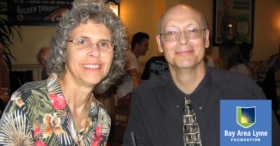
Bay Area Lyme Spotlights Series
“If you have someone who’s sick and you are treating them and they’re not getting better, then either the treatment is wrong or the diagnosis is wrong.”
– David Haney, PhD
Nancy Haney was a highly respected pediatric physical therapist who developed serious health problems that were misdiagnosed over many years, leading to delays in treatment. After exhaustive efforts, it was determined that Nancy had developed an autoimmune condition—likely triggered by Lyme disease—that resulted in debilitating symptoms and complications, including a long-lasting case of shingles, which eventually led to a fatal hemorrhagic stroke. David Haney, Nancy’s husband, recounts his tireless pursuit to find Nancy appropriate care and treatment. Despite his efforts, the mainstream medical system repeatedly failed to correctly diagnose and treat Nancy’s underlying conditions, which led to a tragic and preventable outcome.
David’s story is a call to action for greater awareness, more comprehensive training for doctors, and a fundamental shift in the medical community’s approach to complex, multifaceted infection-associated chronic conditions. Nancy’s case highlights the critical need for improved awareness, diagnostic tools, and treatment approaches for complex cases involving Lyme and tick-borne diseases. Only then can we hope to prevent other families from enduring the same treatment failures as the Haney family.
Nancy’s Lyme disease is diagnosed as Parkinson’s disease
Bay Area Lyme: Tell us about Nancy and when she started developing health problems.
 David Haney: Nancy was the lead physical therapist at Children’s Hospital in San Diego. People revered her and her extensive knowledge of pediatric physical therapy. She was incredibly kind to everyone. When my family met her for the first time, they said to me, “If there’s ever an argument between you and Nancy, we’re taking Nancy’s side!” We had two boys together, Sean and Seth. The first time Nancy’s health was ignored was around 2016. She went to her primary care physician because she was losing her hair. They ignored her. I didn’t think a whole lot about it. At the time, we were dealing with another family member’s illness.
After a lot of research, we found out about Lyme disease. Nancy grew up in Connecticut and Massachusetts, which is Lyme disease country. We had also lived in Wisconsin, which I consider to be a secondary Lyme disease country, and the family lived in the Seattle area for two years—another hot spot for tick-borne disease. In 2017, only three physicians here in San Diego would treat Lyme disease. Since then, two of them have retired, and generally speaking, doctors in California are not as aware of Lyme as in other parts of the country.
“Many physicians in regular healthcare in San Diego say Lyme disease doesn’t exist here, period. Getting them to test for it by expert labs is like pulling teeth.”
Many physicians in regular healthcare in San Diego say Lyme disease doesn’t exist here, period. Getting them to test for it by expert labs is like pulling teeth. They refuse to accept any results from iGeneX, even though they provide testing not only for Lyme, which is Borrelia Burgdorferi (Bb), but all the other infectious agents that ticks vector to humans.
Nancy’s tremor started to show up. We had her tested for Lyme disease, and her test results were positive. She had Bartonella elizabethae (which also cannot be tested for by LabCorp or Quest), including IgM, suggesting an active infection. She had Borrelia burgdorferi (Bb), which is not surprising considering where she grew up.
BAL: How was Nancy’s tremor initially diagnosed?
David Haney: We decided that Nancy should see a Parkinson’s expert. There are two main healthcare systems here in San Diego. One is Scripps Health, and the other is University of California San Diego (UCSD) Health. She went to both hospitals during her illness, and these two systems share information. They did a scan and told her, “You have Parkinson’s disease.” I tried to argue that maybe this was related to her autoimmune problem caused by Lyme disease but was told categorically, “No, she has Parkinson’s.”
That was how it started. I was dissatisfied with the attitude that it couldn’t be anything else. So we went to a different physician, and he said, “It’s Parkinsonism,” but he didn’t know anything about autoimmune diseases. So, we went to an autoimmune disease physician. Nancy had some autoimmune tests done, and we were told that it was either lupus and/or Sjӧgren’s syndrome.
BAL: What happened after the initial diagnosis, and how did things become more complicated?
David Haney: In 2021, Nancy had a pleural effusion. She had a liter and a half of fluid between the space of her lungs and the lung cavity. When the fluid was removed, I asked them to test it for tick-borne infections, and the doctors refused. I asked them to give me or my Lyme physician some of the fluids so that we could have it tested. They refused. In addition to pleural effusion, she also had pericardial effusion.
Doctors disagree on diagnoses, treatment is delayed
BAL: Did you see other doctors? What diagnoses did you receive?

David Haney: Nancy started seeing a cardiologist. The cardiologist was probably the only person at either hospital who believed that Lyme disease was a serious issue. He was the nicest and most responsible person. He treated Nancy for the pericardial effusion, but he couldn’t treat her for Lyme disease because he didn’t know anything about it. However, he did know that it was something that could cause cardiac problems.
When we went to a rheumatologist at one of the hospitals, I tried to suggest that because the tremor Nancy had wasn’t responding to typical Parkinson’s treatment (L-dopa drugs), perhaps it was related to her autoimmune problem. He referred us to an expert in rheumatology at the University of Pittsburgh. The Pittsburgh specialist looked at all of her history and gave her a thorough exam, and he said that she had lupus and Sjӧgren’s. We told him that she’d had exposure to Lyme disease. He had no opinion.
When we came back to San Diego, the doctors disagreed with the physician in Pittsburgh and said she didn’t have lupus. Even within their own ranks, the medical profession can’t agree on things, diagnosis is delayed, and the patient receives poor care because of it.
Bay Area Lyme: Was Nancy ever seen by a neurologist?
David Haney: When Nancy was first seen for the tremor, they thought it was Parkinson’s. They did a brain MRI. It showed that she had both cerebral vasculitis and some minor strokes—not uncommon for older people. In 2022, the other hospital repeated the brain MRI with a more powerful machine and confirmed the earlier findings. I asked the neurologist if some of these things in her brain MRI were causing her tremors. The neurologist said no.
“Even within their own ranks, the medical profession can’t agree on things, diagnosis is delayed, and the patient receives poor care because of it.”
After Nancy died, I did a lot of research, and it’s clear from the research that if you have lupus, you can get cerebral vasculitis. Cerebral vasculitis can cause vascular parkinsonism, and it can be treated with a pulse of high-dose prednisone and cyclophosphamide that puts you into remission from this autoimmune problem. Then, you go on a very low dose of an immune suppressor. Yet, no one at the hospital believed this could be related. I kept asking about treatment with prednisone. Part of the problem is that if you have an infection, it is not usually wise to use immune suppressants. Not enough research has been done to understand how to walk this fine line for tick-borne diseases that cause autoimmune problems. It is frustrating to do the research afterward and discover that this is something they missed. But I missed it, too.
Shingles (varicella-zoster) complicates the picture
Bay Area Lyme: How did things progress after the Sjӧgren’s/lupus diagnosis?
David Haney: Things progressed in a really weird way. Sjӧgren’s/lupus is a severe immune defect, and it is known that people with Sjӧgren’s and lupus can get infected with varicella-zoster (shingles) or have a reemergence from an earlier bout of chickenpox.
In the fall of 2023, I had Bell’s palsy, which is also known to be caused by varicella-zoster and has clear symptoms. My doctor gave me acyclovir and prednisone. Within two weeks, Nancy started to have difficulty swallowing as well as some symptoms one might find in a varicella-zoster infection, like mouth sores, a skin rash, and cognitive issues. I tried to convince people that she may have the same infection, but in her case, the varicella-zoster infection was causing a different problem.
Nancy’s swallowing problem deteriorated to the point where she became malnourished. We went to the hospital again, explaining my Bell’s palsy and that maybe her symptoms were related because she had classic symptoms of shingles, like mouth sores, skin rash, and cognitive problems.

Bay Area Lyme: How can shingles progress if left untreated?
David Haney: If you get varicella-zoster (shingles), it is typically a superficial nerve that gets inflamed, and that’s why you end up with paralysis on the side of your face or pain around your trunk. But it can also become generalized. It’s very rare, but it’s not so rare in people with immune defects. Nancy had an immune defect, and they should have known this.
Generalized varicella-zoster is much more dangerous and causes cognitive decline, yet they didn’t test Nancy for it at all. In the literature, people who come in with the same symptoms that she had—dysphagia (inability to swallow), mouth sores, an odd rash, and cognitive decline—would automatically be tested for varicella-zoster. You can have a PCR test of the cerebrospinal fluid, which is the fluid that runs down the spine and up around the brain, for varicella-zoster.
The hospital didn’t do that. They didn’t even suggest it. They kept saying that it was probably because she had Parkinson’s, and I said, “I don’t believe she has Parkinson’s because she doesn’t respond to any of the Parkinson’s drugs.” The doctors were arguing amongst themselves as to what was causing it. I read their notes afterward. In the end, they decided it was Parkinson’s that caused her dysphagia, but it wasn’t. Parkinson’s can cause cognitive decline, but varicella-zoster causes it a whole lot faster.
Ignoring Nancy’s Lyme leads to serious consequences
Bay Area Lyme: Why do you think so many doctors got so many things wrong?
David Haney: We have a huge problem within the medical industry and how they are disregarding Lyme and tick-borne diseases altogether. In Nancy’s case, the doctors were ignorant of the high risk of varicella-zoster in a person with a severe autoimmune defect. After my experience with this, I believe that Lyme/tick-borne patients should be treated as though they are immune deficient. Instead, they set Nancy up with a speech therapist to help her relearn how to swallow. Because she couldn’t swallow, they put in a G-tube so that she could be fed into the stomach. Yet, she wasn’t able to relearn how to swallow, which isn’t surprising because she continued to have varicella-zoster. The literature makes it very clear that varicella-zoster can be a cause of dysphasia. I believe that between the beginning of November and the end of December 2023, she could have relearned to swallow had they properly treated the varicella-zoster.
On January 1st, 2024, because of the swallowing problem, Nancy ended up having aspiration pneumonia. We went back to the hospital. Initially, she was getting better from pneumonia, but she came down with multiple drug-resistant pseudomonas (bacterial infections). But the doctors finally got her to the point where she could come home. She was getting better at home, but she couldn’t get over the pseudomonas at this point.
Bay Area Lyme: When Nancy got pneumonia, did they put her on antibiotics?
David Haney: Yes. They put her on meropenem, a strong antibiotic, but in their testing of the pseudomonas, the pseudomonas was resistant to meropenem. Then, they put her on an inhaled drug, gentamicin. That drug helped her get over it a little bit, but not enough. So when Nancy came home and had finished the course of antibiotics, she started to get worse again. I took her to see a pulmonologist, and he admitted that they didn’t know how to cure this problem and referred us to an infectious disease doctor. The doctor prescribed a drug combination (ceftazidime/avibactum) that you have to take via the IV route. I administered it at home.
Shingles misdiagnosed, bacterial infection develops
Bay Area Lyme: How did they miss the shingles rash for so long?
 David Haney: When Nancy went into the hospital for the dysphagia back in the fall of 2023, she started to have a rash, which wasn’t classic for shingles, but it was a skin rash that could have been shingles. And that’s true of any shingles or varicella-zoster, which is generalized. The rash won’t look classic. But she had a rash on her face. We had seen a dermatologist at the hospital for it and asked, “Is this related to her autoimmune problem, or is it something else?” They said this is seborrheic dermatitis.
Seborrheic dermatitis is a fairly non-lethal issue. We treated her for this—both when she was in the hospital and while she was being treated for pneumonia. When she came home, it wasn’t improving, and we told the dermatologist. They said, “Oh, you’re not applying it enough,” or one excuse after another. They were absolutely sure that it was seborrheic dermatitis. The antibiotics worked on the pseudomonas, but the rash got much worse.
Nancy became extremely weak and wasn’t able to talk, and her mouth became stuck open. I was worried. We went to see several physicians at the hospital, and they thought that maybe she had a peripheral clot. In addition to all of this, after she started the powerful antibiotics, she started having edema everywhere. They call it anasarca. We were sent to get MRIs of her arms and legs, and they were always negative. Not only did she have edema everywhere, but she again developed a fluid problem in her chest, which made it difficult for her to breathe. She went back to the hospital, and they removed around five liters of fluid from her lungs. It was unbelievable that she was even breathing.
Bay Area Lyme: How did shingles eventually get diagnosed?
David Haney: I questioned the doctors about the rash again. It had gotten very bad. I asked them again to do a punch biopsy. They said we’re certain that this is seborrheic dermatitis. So that went on for about a week, and then they said, “Oh, it must be impetigo.” So, they started treating her for impetigo with a mild antibiotic. After about two weeks, they kept coming back with different excuses as to what the rash might be or what it might not be. I said, “Enough! Do the punch biopsy, and let’s find out what it is and stop guessing.”
When the biopsy results came back, it showed that Nancy had varicella-zoster.
On top of that, the biopsy showed that she had skin changes consistent with autoimmune disease, yet the rheumatologist at the hospital said that her massive acute illness had nothing to do with her autoimmune disease. I didn’t agree with their opinion. I found a doctor in LA who’s an expert in autoimmune diseases. He looked at Nancy’s records online and said, “There’s absolutely no question that she’s suffering from an autoimmune crisis, and she needs to be treated.”
“She was misdiagnosed over and over again. When people ask me, I tell them that she died from Lyme disease and the side effects of Lyme disease.”
Bay Area Lyme: What happened after the confirmation of Nancy’s autoimmune disease?
David Haney: When Nancy was in the hospital, I wrote a letter to the hospital administration. They finally took it seriously, and a whole bunch of people got upset. They finally agreed that, yes, she did have an autoimmune problem, but in the meantime, they discovered Nancy also had cancer.
An MRI of Nancy’s neck showed that she had bone changes that might suggest cancer. A doctor in the breast cancer unit at the hospital looked at those x-rays and other data and said she was absolutely 100% positive Nancy had a particular type of breast cancer and to treat with an aromatase inhibitor, and they wanted to do a bone biopsy. Nancy was acutely ill on her deathbed, and I said, “Let’s start her on the aromatase inhibitor. It’s not that dangerous of a drug.” And she agreed.
So they started her on the aromatase inhibitor, and about a week later, after they had studied the fluid more, they determined that it couldn’t be breast cancer. They decided it had to be a cancer from the abdominal cavity, maybe ovarian cancer. The breast cancer people said the next step is to do imaging.
In this case, it was the gynecology oncologists who said they weren’t going to do any more imaging. They said Nancy was too acutely ill to be treated, and the acute illness was not related to whatever cancer she might have. I was upset. The doctor in LA was very disappointed that they refused to do any more imaging.
Things were a total disaster. It’s not uncommon for people who are exposed to varicella-zoster (shingles) over a long period to get cancer. Perhaps the cancer was caused by them never diagnosing the varicella-zoster.
Other missed symptoms lead to Nancy’s decline
Bay Area Lyme: What other ways did varicella-zoster present in Nancy’s case?

David Haney: When they finally confirmed from the punch biopsy that Nancy had varicella-zoster and cognitive dysfunction, she had this other problem: she had her mouth open the whole time. I kept asking about it, and they didn’t have an answer. After Nancy died, I looked in the literature and discovered that if you have a varicella-zoster infection in the brainstem, that will happen. I asked the physicians, I asked the PT, and I asked the speech pathologist several times, “Why is her mouth open?” They said, “Oh, just slowly push it closed. That’ll fix it.” That wouldn’t fix it because that’s probably a brainstem issue.
They finished treating her for varicella-zoster. It was seven days of IV acyclovir and seven days of oral acyclovir. It should have been at least 14 days of IV acyclovir for a CNS infection. However, they decided that that was the treatment because they only considered the skin infection. They also treated the pseudomonas infection. The pseudomonas did get better, but it didn’t get better until the end of the acyclovir treatment. So, another possibility is that her lung problem was that she had varicella-zoster pneumonia. Again, it’s very rare, but they could have considered that. They could have tested her for it, but they didn’t.
“One of the problems is that medicine has become too specialized, so even though they have teams that are supposed to talk to one another, there’s nobody that takes care of the whole person.”
Bay Area Lyme: At this point, Nancy’s condition was obviously very poor. What did you do?
David Haney: I brought Nancy home and put her in a hospital bed. Her jaw was still completely open. I was doing all of her tube feeds. I was doing all of her meds. I slept on the floor next to her hospital bed to make sure that if anything happened, I’d be right there. We had a PT and an OT coming in and a nurse coming in. But one day, she became unresponsive. I wasn’t able to get a blood pressure reading. Finally, she would stop breathing. I would pound her on the chest, and she’d start breathing again. But it kept happening, and I finally called my son. I told him that either this was the end or I would take her to the hospital.
I took her to the hospital, and after three days, they tested the opening and closing of her pupils, and they said she was not responding. They took her in for a brain CT scan and found a massive brain bleed, which they said she couldn’t recover from. We agreed to have all of the equipment turned off, and she died.
Again, in the literature, it’s known that if you have a central nervous system (CNS) or brain infection with varicella-zoster, a hemorrhagic stroke is a common side effect. So, while Nancy maybe didn’t die from Lyme disease, it was because she was misdiagnosed over and over again. In my opinion, I believe that physicians, including Lyme doctors, need to recognize that Lyme/tick-borne patients can be at high risk for varicella roster. Not only are doctors poorly trained when it comes to treating Lyme disease, but they’re clearly lacking in knowledge when it comes to treating varicella-zoster. Maybe they do not consider Lyme or lupus to be a serious immune defect, but I think it clearly is, and these patients need to be considered at high risk of unusual types of infection like generalized varicella-zoster.
No accountability for delayed diagnoses and misdiagnoses
Bay Area Lyme: You wrote to the hospital about your experience with Nancy’s delayed and missed diagnoses. Have you received any kind of response?
David Haney: Nothing. One of the problems is that medicine has become too specialized, so even though they have teams that are supposed to talk to one another, there’s nobody that takes care of the whole person. No one was able to look at this whole picture and say, “This is what the problem is, and let’s solve it!”
“I believe that physicians, including Lyme doctors, need to recognize that all Lyme/tick-borne patients can be at high risk for varicella-zoster.”
The people I ended up struggling the most with were what they call ‘first call residents’—typically less experienced than other attending physicians. All they do is manage the care for other physicians. Many of them did not understand me when I asked complicated medical questions. The physicians are running in different directions, and nobody is pulling the whole complicated medical issue together as an overall case manager. You need a diagnostician who is curious and who believes that if you have someone who’s sick and you are treating them and they are not getting better, then either the treatment is wrong or the diagnosis is wrong.
After Nancy died, we requested an autopsy in addition to arranging for tissue donation to Lyme Disease Biobank. Unfortunately, the Medical Examiner (ME), for unknown reasons, took possession of the body but never did an autopsy. In order to meet the requirements for the Lyme Disease Biobank, we had to forego an autopsy due to the ME’s actions. The ME just looked at the paperwork from the hospitals, and they came up with that she had died from a hemorrhagic stroke. That part is absolutely clear. They didn’t reference lupus or Sjӧgren’s, Lyme disease or varicella-zoster. I ended up sending half a dozen emails to the ME’s office and tried to point this out. The report was inaccurate. In the end, the ME agreed to say that she had an autoimmune problem. He refused to put Lyme disease on the death certificate.
Nancy did donate tissues to the Lyme Disease Biobank so that maybe researchers can help prevent others from this suffering. But when people ask me, I tell them that Nancy died from Lyme disease and the side effects of Lyme disease.
A Nancy B. Haney Memorial Pediatric Physical Therapy Award at Rosalind Franklin University, Chicago, IL, and a Nancy B. Haney Endowed Fund (physical therapy lectureship) at Rady Children’s Hospital, San Diego, CA, have been created in Nancy’s honor. David and Nancy’s son, Sean Haney, passed away in 2021 due to heart complications from undiagnosed tick-borne disease. An annual memorial symposium at Scripps Institution of Oceanography in San Diego was created to honor Sean. This blog is part of our BAL Spotlights series. If you require a copy of this article in a bigger typeface and/or double-spaced layout, contact us here. Bay Area Lyme Foundation provides reliable, fact-based information about Lyme and tick-borne diseases so that prevention and the importance of early treatment are common knowledge. For more information about Bay Area Lyme, including our research and prevention programs, go to www.bayarealyme.org. Legal Disclaimer The contents of this blog, including but not limited to interviews, articles, and opinions, are for informational purposes only and are not intended as medical advice, diagnosis, or treatment. The views expressed by interviewees are their own and do not necessarily reflect the opinions of Bay Area Lyme Foundation. Readers should always consult a qualified healthcare professional before making any medical decisions. Reliance on any information provided on this blog is solely at your own risk. Bay Area Lyme Foundation and its contributors expressly disclaim any liability for any direct, indirect, incidental, or consequential harm arising from the use or interpretation of the information presented here. By accessing this blog, you acknowledge and agree to these terms. Nancy B. Haney, born Nancy Burritt in March 1952 in Greenfield, MA, graduated from East Longmeadow High School in 1970 and earned a degree in Physical Therapy from Boston University in 1974. She married in August 1974, crafting her own wedding dress, and worked as a PT in Boston and Chicago before specializing in pediatric physical therapy. Nancy practiced in Northern Suburban Chicago schools and UCP Long Island before moving to Wisconsin in 1982, where she opened a pediatric PT office and had her sons, Seth and Sean. Relocating to San Diego in 1987, she established a private practice and worked at Rady Children’s Hospital. Nancy went back to school at 44 to earn a master’s in pediatric PT research. She returned to Rady Children’s until retiring as lead PT in 2020. A dedicated professional and loving mother, Nancy was also an expert sailor, skilled seamstress, and meticulous vacation planner, always balancing her career and family with care and creativity.
 David N. Haney, PhD, was born in February 1953 in Springfield, IL, and grew up in Mt. Prospect, graduating from John Hersey High School in 1971. He studied chemistry at Boston University, where he met his wife, Nancy, and they married in 1974. David earned his PhD in biochemistry from Northwestern University in 1980 and conducted postdoctoral research at Brookhaven National Laboratory. After working at Kimberly-Clark from 1982-1987, he joined Biosym Technologies in San Diego. Later, he pursued pharmaceutical consulting until retiring in 2020. If you have heard of the hemoglobin A1c test, David was closely involved in that early research. David devoted much of 2018-2021 to caring for his son Sean, who tragically passed in 2021 from complications of tick-borne diseases. He also supported Nancy through her battle with Lyme disease, lupus, and Parkinsonism. Despite his efforts, Nancy passed away in 2024 due to a stroke linked to complications from misdiagnosed shingles, which she suffered from because of Lyme disease.
Thank you for sharing and I’m sorry for both of your losses. How horrible. My father was diagnosed seronegative myasthenia gravis by 2 doctors however an independent neurologist said ALS due to the EMG test he did. She only tested the upper motor neurons when both upper and lower are supposed to be done as well as rule out any other disease it may mimic like MG. didn’t know he had a thymoma (50% of thymoma patients have MG). My dad had a crisis, went to hospital and they treated him with prednisone and super Medrol IVIG. He improved tremendously per the ER doctor….I got his records after he passed. Obviously, the doctors didn’t read each other’s notes, or the pulmonologist would have seen that it was not ALS. My dad wasn’t even there to be diagnosed; he had a crisis then a thymectomy. Why when the hospital wasn’t sure which disease he had, although I know it was MG. I saw him improve on mestinon. He’s sleeping doing better than he has in 2 weeks and a respiratory therapist came in to adjust his nose piece; he was wearing a very forceful oxygen delivery system. He cut the inside of his nose and he bleed, being on blood thinners it was a lot. I turned around and a moment later his mouth was full of blood. He couldnt swallow due to his autoimmune disease so he was on a feeding tube. He aspirated all that blood for over an hour before a doctor came in. He went into respiratory failure and I was told he would not come off the respirator. I failed to ask why. I was in shock. I witnessed the entire thing. My dads eyes staring at me not being able to talk haunts me. The same hospital with the same doctors misdiagnosed my dad. I would have not known this if I didn’t read his notes after the fact. I’m haunted. I should have stopped the bleeding. The nurse had said leave it alone, she was too busy to help since she was at the other end of the hallway with an emergency. Excuse me! My dad was an emergency. I wonder how she feels now. Besides what trauma my father had to go through, I am living this nightmare continually. It’s on auto replay. I see it all, I hear him gurgle on his blood. And no one is in trouble? I don’t know what to do. I need to write someone. This isn’t fair. To my dad or me. I have a psychiatrist and psychologist. Nightmares, paranoia. Its ruining my 8-year relationship. The guilt is unbearable. RIP William Angelo Navarette 10/22/50-7/31/25
We’re so very sorry for the loss of your father.
Thank you for sharing your story with all of us. I live with chronic Lyme and got bit when I was around 12 years old. I am now in my 30s and all the doctors refuse to give me more treatment since they said I have had rounds of doxycycline before for other infections. They said that is the only known medication at Kaiser and have refused to help me. Hearing stories like this might help me in the future to try and advocate for myself. Living with a disease no one wants to acknowledge is hard, I am so sorry for your loss.