CRISPR Technology: A New Approach to Eradicating Borrelia

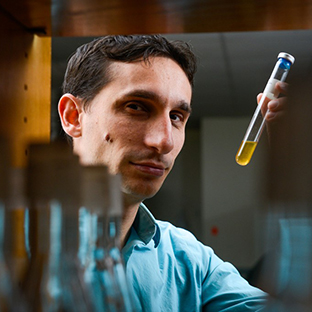
courtesy Beisel Lab, NCSUDr. Chase Beisel is an Assistant Professor at North Carolina State University who was recognized earlier this year with one of Bay Area Lyme Foundation’s prestigious Emerging Leader Awards. This honor is in recognition of and support for his lab‘s novel work exploring CRISPR technology as a potential treatment for Lyme infections.

Dr. Beisel’s work integrates molecular biology, chemical engineering, and mathematical modeling and has been acknowledged with several National Science Foundation (NSF),  National Institute for Health (NIH) and other important awards. His foray into the field of Lyme is a new direction for his lab and ties directly to the Foundation’s aim of attracting some of the brightest and best minds in the country to apply innovative new approaches and methodology to accelerate the development of new diagnostics and treatments for Lyme disease. We are excited about his work and asked him to elaborate further in this recent conversation.

New Pathogen Discovered By Researchers Who Discovered Lyme – But Was Not Reported

FOR IMMEDIATE RELEASE

Media Contact:
Tara DiMilia, 908-947-0500, tara.dimilia@TMstrat.com

New Pathogen Discovered By Researchers Who Discovered Lyme – But Was Not Reported

Bay Area Lyme Foundation Responds to News Related to Initial Studies of Lyme Disease

Portola Valley, CA, October 12, 2016 – Bay Area Lyme Foundation, an organization dedicated to making Lyme disease easy to diagnose and simple to cure, is deeply disturbed by the news that researchers involved in the initial discoveries of Lyme disease omitted critical information related to additional bacteria that may have contributed to illness in early cases. This information was revealed in a story today in STAT News titled “The ‘Swiss Agent’: Long forgotten research unearths new mystery about Lyme disease.”

This new development clearly points to a critical need to reexamine much of the current orthodoxy in Lyme disease.

Bay Area Lyme Foundation Announces Winners of “Lyme Innovation” Hackathon at White House Event

FOR IMMEDIATE RELEASE

Media Contact:
Tara DiMilia, 908-947-0500, tara.dimilia@TMstrat.com

Bay Area Lyme Foundation Announces Winners of “Lyme Innovation” Hackathon at White House Event

White House Acknowledges Contributions of Program Organizers
Toward Solving Challenges of Lyme Disease

(Cambridge, MA,) October 5, 2016 — As part of the White House Open Data Innovation Summit, Bay Area Lyme Foundation, collaborating with the Spaulding Rehabilitation Network’s Dean Center for Tick Borne Illness, Harvard Medical School Department of Physical Medicine and Rehabilitation, MIT Hacking Medicine, University of California, Berkeley, and the Veterans Affairs Center for Innovation, announces the winning teams of Lyme Innovation.  Lyme Innovation is the first ever Hackathon for Lyme disease, which provided a forum for more than 100 scientists, clinicians, researchers, entrepreneurs, and investors from a variety of disciplines to brainstorm solutions for this potentially devastating disease.

Bay Area Lyme Foundation Increases Annual ‘Emerging Leader Award’ Grants to $350,000 for Lyme Disease Research

FOR IMMEDIATE RELEASE

Media Contact:
Tara DiMilia, 908-947-0500, tara.dimilia@TMstrat.com

Bay Area Lyme Foundation Increases Annual ‘Emerging Leader Award’ Grants to $350,000 for Lyme Disease Research

2017 additional award invites applications from Associate Professors through Full Professors

Silicon Valley, California, October 3, 2016 – Bay Area Lyme Foundation, supporter of research aimed at making Lyme disease easy to diagnose and simple to cure, announced today that it is beginning to accept applications for a new $250,000 grant award that has been added to its existing “Emerging Leader Award” portfolio of yearly funding.  Made available to researchers through the generosity of the Steven and Alexandra Cohen Foundation and the Laurel Foundation, the portfolio also includes the $100,000 “Emerging Leader Award” which has previously been granted to researchers from Harvard, Stanford, UCSF, NC State and Louisiana State University.

Had a Good Day? Call in Sick.

jordan-fisher-smith_312Wednesday evening September 14th, Jordan Fisher Smith, Lyme patient, former National Park Service (NPS) ranger and US Forest Service firefighter, narrator of the Lyme documentary Under Our Skin, freelance writer, and author of bestselling books, Nature Noir: A Park Ranger’s Patrol in the Sierra and Engineering Eden: The True Story of a Violent Death, a Trial, and the Fight Over Controlling Nature, was the latest to grace the Bay Area Lyme stage as part of the Distinguished Speaker Series. This free public series features noted scientists, health professionals, and Lyme advocates in intimate salon-style settings, where audience members can ask questions and get answers about the latest in Lyme disease research, treatments, and policy news. And sometimes, it’s just about sharing stories and insights.
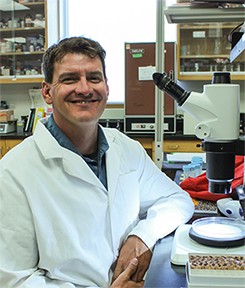
This week’s presentation was just that — a moving discussion of Jordan’s personal experience and reflections battling Lyme disease, what he describes as the toughest 9 1/2 years and biggest struggle of his life (and this from a man who nearly lost his life during blizzard conditions on the top of Mt. Shasta!).

Ticks, Ticks, and More Ticks!

A Conversation with Dr. Nate Nieto, Northern Arizona University and Head of the Free Tick Testing Program


Nate Nieto_312Just six months ago, Bay Area Lyme launched a free Tick Testing Program through a partnership with Nate Nieto, PhD, Assistant Professor, Department of Biological Sciences at Northern Arizona University, and his lab.
The lab accept ticks from any state in the US and ticks are tested for several bacterial infections. The goal is to learn more about the ecological distribution of the major tick vectors and the prevalence of tick-borne pathogens that people encounter in different locations around the country ultimately to improve both prevention and diagnostic measures.

The initial response to this program far exceeded any anticipations — thousands of ticks poured in from all over the nation! Here, we sat down with Dr. Nieto to talk about what he has seen in these first few months and how the program will continue to grow and evolve. 

For more information about how to submit a sample, please refer to the Tick Testing page.

Bay Area Lyme Foundation Announces Finalists of “Lyme Innovation” Hackathon

FOR IMMEDIATE RELEASE

Media Contact:
Tara DiMilia, 908-947-0500, tara.dimilia@TMstrat.com

Bay Area Lyme Foundation Announces Finalists of “Lyme Innovation” Hackathon

Event brings together research from other therapeutic areas and disciplines to collaborate in development of solutions

Cambridge, MA, June 24, 2016 – Bay Area Lyme Foundation, collaborating with the Spaulding Rehabilitation Network’s Dean Center for Tick Borne Illness, Harvard Medical School Department of Physical Medicine and Rehabilitation, MIT Hacking Medicine, University of California, Berkeley, and the Veterans Affairs Center for Innovation, today announced the five finalists of Lyme Innovation, the first ever Hackathon for Lyme disease.  More than 100 scientists, clinicians, researchers, entrepreneurs, and investors from several US states registered for this event to brainstorm solutions for Lyme disease, a potentially devastating condition newly infecting 329,000 people each year.

“Collaboration is the key to solving the myriad of challenges of Lyme disease, and we were excited to have the participation of so many researchers new to Lyme research,” said Wendy Adams, Science Committee, Bay Area Lyme Foundation.  “It has been exciting to see such a wide range of expertise and enthusiasm come together to focus on solutions for this serious disease.”

American Ninja Warrior Elet Hall Educates about Lyme Disease Risks

FOR IMMEDIATE RELEASE

Media Contact:
Tara DiMilia, 908-947-0500, tara.dimilia@TMstrat.com

American Ninja Warrior Elet Hall Educates about Lyme Disease Risks

Growing issue of Lyme disease in California prompts Association for Environmental and Outdoor Education (AEOE) to provide Lyme education at statewide conference

Silicon Valley, CA, May 9, 2016 — Bay Area Lyme Foundation, a leading non-profit funder and advocate of innovative Lyme disease research in the US, today announced that Elet Hall, ambassador for the Bay Area Lyme Foundation, and Jo Ellis, director, education outreach, Bay Area Lyme Foundation helped raise awareness about Lyme disease and tick-borne illnesses among California Association for Environmental and Outdoor Education (AEOE) conference attendees.  Attendees included individuals who work in museums, zoos, nature centers, and state and national parks as well as environmental and outdoor educators who help instill an understanding of nature to individuals of all ages, from California and neighboring states.

Beware the Questing Tick!

May is Lyme Awareness month. And it is indeed time to be aware. Thanks to El Niño, it’s a wetter Spring than we’ve had in several years. That means we have lots of green grass, damp leaf litter, and overgrown trails and paths. It also means the ticks are out. And early spring means nymph season — these nymphs are young ticks, not much bigger than a poppy seed … the kind that are easy to miss with a quick glance.

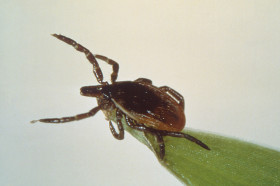
Anna Perez This photograph depicts a deer tick, or blacklegged tick, Ixodes scapularis, as it was questing on a blade of grass.The Lyme disease bacterium, Borrelia burgdorferi, is spread through the bite of infected ticks. The blacklegged tick (or deer tick, Ixodes scapularis) spreads the disease in the northeastern, mid-Atlantic, and north-central United States, and the western blacklegged tick, Ixodes pacificus, spreads the disease on the Pacific Coast. Ticks can attach to any part of the human body but are often found in hard-to-see areas such as the groin, armpits, and scalp. In most cases, the tick must be attached for 36-48 hours or more before the Lyme disease bacterium can be transmitted.Most humans are infected through the bites of immature ticks called nymphs. Nymphs are tiny (less than 2mm) and difficult to see; they feed during the spring and summer months. Adult ticks can also transmit Lyme disease bacteria, but they are much larger and may be more likely to be discovered and removed before they have had time to transmit the bacteria. Adult Ixodes ticks are most active during the cooler months of the year.
Adult Ixodes tick questing. Photo by Anna Perez, courtesy of CDC (Centers for Disease Control and Prevention)

The good news is that ticks can’t fly, jump, or even run. But they do “quest” — they hang out on leaves, blades of grass, and branches, tiny legs poised to grab onto a warm body passing by. Ticks need to feed in order to progress to the next life stage and perching ready to grab a free ride (and meal!) on an unwitting passerby is how they ensure their survival.

When hiking or biking in the woods, if you keep to the center of the trail and avoid bushwhacking and brushing up against high grasses or other vegetation, your risk of picking up a parasitic passenger is pretty low. Once you leave the trail for a pit stop, however, the risk rises exponentially. Ticks are carried by deer and other small mammals that also like to use the trails so the highest concentration of ticks is often close to trails.