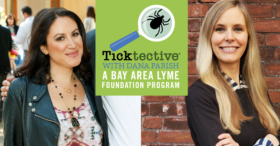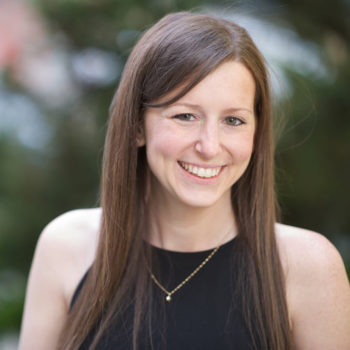
Dana Parish interviews Dr. Kenneth Liegner, a Board Certified Internist practicing in Pawling, New York. He has been on the front lines of treating chronic Lyme and related infections since 1988. He has published in peer-reviewed scientific journals and is the author of In the Crucible of Chronic Lyme Disease—Collected Writings & Associated Materials.
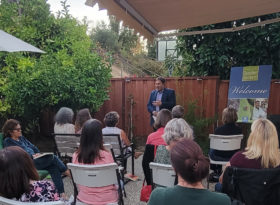
Dr Steven Harris speaking at the Bay Area Lyme Speaker Series in San Jose, September 29, 2022
Dr. Steven Harris, a physician specializing in Lyme at Pacific Frontier Medical, was guest speaker as part of our Distinguished Speaker Series. His presentation on the complexity of tick-borne diseases is transcribed below to share his invaluable insights into novel treatment options for those living with chronic/persistent Lyme and other intractable infections that severely curtail patients’ quality of life, bringing hope and restoring health to many. Note: This transcribed presentation has been edited for clarity.
What is “Precision Medicine”?
“The concept of precision medicine, which is a growing area, is where we look at an individual and try to create a tailored plan for that person. I think many doctors wish that we could have a ‘cookbook’ approach to medicine that would work for our patients. But unfortunately, that approach doesn’t work. Luckily, here in the San Francisco Bay Area, there are doctors offering precision medicine including Dr. Sunjya Schweig in Berkeley, Dr. Christine Green, with us at Pacific Frontier Medical, and Dr. Eric Gordon, at Gordon Medical Associates in Marin and others. And thankfully, we have Stanford and UCSF (our local medical centers) that we work peripherally with. In addition, the Open Medicine Foundation is making great strides in understanding illness and Dr. Mike Snyder’s group at Stanford who are working on multi omics for chronic fatigue that track an individual patient’s data.
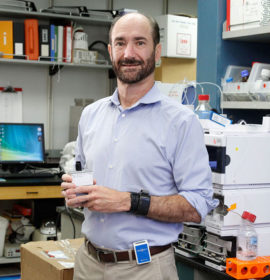
Mike Snyder, PhD, Stanford University
“These doctors are working in their own fields, not necessarily just tick-borne diseases, but our work overlaps. For example, the Snyder Lab multi-omic study involves genomics, epigenomics, metabolomics, where they are looking at tons of data and assimilating a lot of this different data to try to create treatment plans that work for the individual, because of the fact that a ‘cookbook’ approach doesn’t work for this group of chronic complex patients. For example, we look at someone’s multi-ome and the parts that make them up, including their microbiome, epigenome among many others, which is becoming a bigger and more exciting field. One of the practical aspects we try to determine is how to address an individual’s level of inflammation, the diversity of their personal bacterial flora, and how to help compensate for any deficiencies—or over abundances—that help contribute to disease.
In this insightful conversation between Ticktective™ guest host Dana Parish and microbiologist Amy Proal, PhD, we investigate persistent pathogens, how they remain in the body after treatment often leading to chronic illness, and how they can be reactivated by new infections, including Covid-19. Note: This transcribed podcast has been edited for clarity.
Dana Parish: Welcome to the Ticktective Podcast, a program of the Bay Area Lyme Foundation, where our mission is to make Lyme disease easy to diagnose and simple to cure. I’m your guest host today, Dana Parish. I’m the co-author of the book Chronic, and I’m on the advisory board of Bay Area Lyme Foundation. This program offers insightful interviews with clinicians, scientists, patients, and other interesting people. We’re a nonprofit foundation based in Silicon Valley, and thanks to a generous grant that covers a hundred percent of our overhead, all your donations go directly to our research and our prevention programs. For more information about Lyme disease, please visit us at www.bayarealyme.org.
Amy Proal, PhD
Today, on behalf of Bay Area Lyme Foundation, I am here with brilliant microbiologist Dr. Amy Proal. I have a little bio for her. I’m going to read right now. Dr. Proal serves as president and CEO of PolyBio Research Foundation, and she’s the chief scientific officer of the Long Covid Research Initiative, LCRI. She went to Georgetown, she has a PhD in microbiology from Murdoch University in Australia, and she is a rockstar in the field and a leader in the field of persistent pathogens. She has just come off of a huge press tour for her incredible work and the enormous grant that she just received for her Long Covid research, and I’m so excited to be one of the first people to talk to you after all this.
Amy Proal, PhD: Of course, Dana, thanks so much for having me. That was an amazing intro. I appreciate all of that. It’s great to be interviewed by you. It’s mostly just a friendly conversation, which is fun.
Dana Parish: So, congratulations on your grant. I found out about it all coming together because I saw it in Forbes and then in the LA Times, and then I saw it in the Financial Times and I was like, “Oh my God. This is front page news!” Can you talk a little bit about the work you’re doing in Long Covid?
“With the lack of government initiative to make Lyme and tick-borne diseases easy to diagnose and simple to cure, it’s up to organizations like Bay Area Lyme and Lyme Disease Biobank to expand our understanding of tick-borne diseases.” –Harrison S., LDB participant
“I participated in the Biobank program because I want to support legitimate science—it’s the compass pointing us in the direction that will lead to better diagnostics and therapeutics for Lyme patients. I am grateful that BAL is funding this critical research which is so sorely needed, and doing it expeditiously. It goes a long way to make up for the five decades of inaction by the CDC and HHS.” – Rebecca W., LDB participant
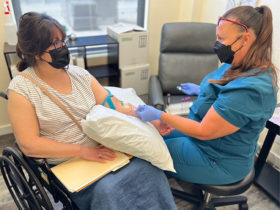
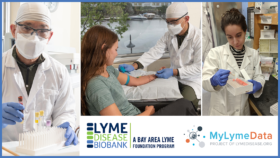
Over three days in June, the Lyme Disease Biobank (LDB) welcomed participants to Gordon Medical Associates, our LDB collection site in San Rafael, CA. Persistent/chronic Lyme patients traveled from as far away as Sacramento, CA, and Reno, NV, to donate blood and urine samples to the Biobank. LDB, a program of Bay Area Lyme Foundation, was founded to ensure an adequate number of samples for researchers investigating Lyme and tick-borne diseases.
How a chance meeting and the harnessing of big data led to a research initiative that’s finding answers in Lyme and tick-borne disease
Many different groups comprise the Lyme disease community including patients, their families, healthcare providers, researchers and nonprofit organizations. These nonprofit organizations and foundations may differ in size, structure, fiscal basis, focus and approach, but in one important aspect they are united: the search for answers.
This search for answers in the realm of Lyme and tick-borne diseases has served as a unifying driver, even when dissent and controversy has sometimes fragmented the Lyme community. And despite what seems to be a constant uphill battle for recognition and legitimacy of Lyme and tick-borne infections, many believe that we’re on the brink of major breakthroughs to help patients and doctors unlock the medical mysteries that make these infectious diseases so confounding. Two people cautiously optimistic about where we are in the search for answers about Lyme are Liz Horn, PhD, MBI, Principal Investigator, Lyme Disease Biobank, and Lorraine Johnson, JD, MBA, Chief Executive Officer, LymeDisease.org and Principal Investigator MyLymeData.
– Wendy Adams, Research Grant Director, Bay Area Lyme Foundation
This pandemic has brought many different modalities in diagnostics, drug development and vaccines to the popular press. In the Tick-borne Disease (TBD) community, we have seen the issues that arise when the timely diagnosis and treatment of infectious disease are hampered by insensitive diagnostics and ineffective treatments.
It bears repeating however, that drugs that fight the infection in question (antibiotics, antiparasitics, or antivirals) are a large part of any eventual solution to an outbreak, especially in advance of a vaccine (see HIV). Antimicrobial therapeutics help keep the pathogen from replicating uncontrolled, allowing the complicated immune system processes to catch up to it, control it and then eradicate it.
One specific treatment modality is being widely discussed: monoclonal antibodies (mAbs). These are the drugs upon which the whole biotech industry and companies like Genentech, Biogen and Amgen were literally built. Six out of the top 10 drugs by sales are mAbs, mostly for oncology and autoimmune disease indications. However, mAbs have not been commonly used for infectious disease (with one major exception we’ll talk about later).
What are monoclonal antibodies? How do they work?
Antibodies are proteins made by the mammalian immune system. They are a workhorse of the acquired immune response and fight specific antigens, which can be anything from an invading pathogen to an aberrant cell or cytokine that needs destruction. Monoclonal antibodies as a drug class are also very specific and only bind to one antigen. They can bind to a single receptor on the outside of a cell, so that cell can’t receive or send out a message. Or the cell can be tagged so the immune system recognizes the cell as foreign and can destroy it. Binding only one target is important to reduce side effects caused by binding to multiple targets.
Guest Post from
Michelle McKeon, MS
President, Lyme and Cancer Services
Bay Area Lyme is happy to share the editorial contributions of care providers, patients, caregivers, and others in the community who are eager to share their knowledge for the benefit of others suffering from Lyme and related tick-borne illnesses. There is still so much we don’t know and so much we are just learning. It is critical that we keep an active dialogue and share and collaborate to continue to move our understanding forward. What follows is an article written by a guest contributor and practicing care provider who shares that view and her personal and professional experience in hopes that it can help others with their healing journeys.
Bay Area Lyme Foundation Responds to NY Times Story
We are thrilled for the Mandavilli family, who shared that their son responded well to treatment for Lyme disease in The New York Times story My Son Got Lyme Disease. He’s Totally Fine. This is not the case for everyone, and it is irresponsible, and scientifically inaccurate, to blanketly define Lyme, and other tick-borne diseases, as “easily treated”. This one patient’s experience can be countered by hundreds of other patients whose disease has brought their lives to a halt. It does a huge disservice to patients whose families read stories like this and question the patient’s symptoms, and whose community doctors see reports like this and refuse much-needed treatment. The joy of the Mandavilli family should be heralded as a success but not an example.
The CDC has reported deaths due to Lyme disease beginning as early as 2013, with most caused by Lyme carditis, a condition in which the bacteria invades the heart.And, the ability of this bacteria to invade other organs, including the brain, and cause paralysis is well-documented. Several celebrities including Alec Baldwin, Avril Lavigne, Yolanda Hadid and Kelly Osborne have by their own accounts believed that they were near death due to Lyme disease. Clearly, the singular experience of the Mandavilli family is not broadly representative of what every person with Lyme experiences.
Grants are designed to inspire new research to address the challenges of Lyme disease
PORTOLA VALLEY, Calif., January 15, 2019—Bay Area Lyme Foundation, a leading sponsor of Lyme disease research in the US, is announcing a call for entries for their 2019 Emerging Leader Awards (ELA), which are designed to encourage promising scientists who embody the future of Lyme disease research leadership in the US. This year, two $100,000 grants will be awarded in May. Recipients will be researchers from academia or the private sector who are currently at the post-doctoral through the assistant professor level or equivalent, and who have demonstrated professional and scientific leadership in the biomedical sciences. They should have a defined approach that offers scientific rationale for a research project that can advance diagnostics or treatments for Lyme disease. Proof of concept for the $100,000 awards should be feasible in 12–18 months.
These awards, along with other Bay Area Lyme Foundation efforts, aim to fill a gap as the National Institutes of Health (NIH) funding for Lyme disease research is insufficient. While there are nearly 10 times as many people diagnosed each year with Lyme than HIV in the US, Lyme disease receives approximately 1% of the public funding that is allocated for HIV/AIDS.
The Foundation encourages Congress to support the recommendations to fund efforts to increase scientific understanding of Lyme disease and other tick-borne infections
Portola Valley, Calif., November 14, 2018—Bay Area Lyme Foundation, a leading sponsor of Lyme disease research in the United States, offered their appreciation to the U.S. Department of Health and Human Services (HHS) in response to The Tick-Borne Disease Working Group’s recommendation for increased Federal investment focused on Lyme disease awareness, education, diagnosis and treatment. This Federal Advisory Committee was enshrined in the 21st Century Cures Act, after years of work by Lyme disease advocates and their congressional representatives to review the Federal Government’s activities on tick-borne disease.
“This document represents an important first step by the U.S. federal government to recognize the need to better address tick-borne diseases,” said Wendy Adams, Research Grant Director, Bay Area Lyme Foundation and Member, Tick-Borne Disease Working Group. “These recommendations make the powerful point that significant increases in federal government funding for tick-borne disease research are required before we can truly diagnose and treat tick-borne infections.”
While there are nearly 10 times as many people diagnosed each year with Lyme than HIV in the U.S., Lyme disease receives approximately 1% of the public funding that is allocated for HIV/AIDS.