The December 15, 2025, HHS roundtable on Lyme disease and other tick-borne diseases placed long-overdue national attention on the millions of patients and families who have lived with an “invisible illness” for far too long. One of the clearest messages of the event was that the era of dismissing or gaslighting Lyme patients must end. This reflects what our community has endured for years.
Secretary Kennedy Convenes Lyme Disease Patients and Providers to Announce New Diagnostic Efforts
The Bay Area Lyme Foundation welcomes this federal focus on the urgent need for accurate diagnostics, rigorous patient-centered research, and better access to care, including the acknowledgment that Lyme disease qualifies as a chronic condition within Medicare care frameworks. These priorities closely align with, and have long guided, the work we have led for more than a decade.
We initiated the Lyme Disease Biobank, which is now a cornerstone resource for diagnostic and translational research across the country and has attracted significant support from the Steven and Alexandra Cohen Foundation. Through additional philanthropic investment and scientific collaboration, Bay Area Lyme has also supported or co-funded many of the research advances referenced throughout the roundtable.
“I’ve always said that the FDA has been captured by the pharmaceutical industry. They don’t have our best interests at heart. You shouldn’t be funded by the people you’re supposed to be regulating.”
– Steven Phillips, MD
Ticktective host, Dana Parish, talks with her longtime collaborator and co-author of Chronic, Dr. Steven Phillips, a Yale-trained internal medicine doctor who specializes in treating patients with complex, chronic illnesses, often driven by underlying infections like Lyme, Bartonella, Babesia, and now, COVID. In this podcast episode, Phillips discusses the importance of getting to the root cause of mystery autoimmune illnesses, rather than just suppressing symptoms. He states that many chronic infections can drive autoimmune conditions, including Lyme disease, and that Lyme tests are often inaccurate, with a sensitivity of around 50%. Phillips discusses how he recommends treating suspected tick bites to prevent the development of chronic Lyme disease and his use of a multi-antibiotic approach and pulsed antibiotic therapy to target persistent infections. He also discusses his experiences treating COVID-19, using a multi-modal approach including doxycycline, Paxlovid, Metformin, and other drugs and supplements, and the reactivation of infections like Bartonella in Long COVID patients. They also discuss how the chemical and pharmaceutical industries’ interests do not necessarily align with patients trying to get well. The interview highlights Dr. Phillips’s expertise in treating complex chronic infections and his holistic, evidence-based approach to patient care.
“The opening of a network of Lyme disease clinics is the culmination of many years of tireless work and the vision of a small group of determined women over 10 years ago. We are extremely optimistic that the Lyme Clinical Trials Network will accelerate the development of new treatments for patients with post-treatment and persistent Lyme disease.”
—Linda Giampa, Executive Director, Bay Area Lyme Foundation
When Bay Area Lyme Foundation (BAL) was formed a decade ago, its mission was clear: to make Lyme disease easy to diagnose and simple to cure. “And that’s still our goal,” emphasizes BAL co-founder Bonnie Crater, as she reflects on the last 10 years. However, appreciating the magnitude of the Foundation’s audacious mission requires an understanding of two complex—yet inextricably linked—medical domains: the world of diagnostics, and the world of therapeutics.
Bay Area Lyme Co-Founder Bonnie Crater
The ‘Holy Grail’ for Lyme disease is an accurate diagnostic test—or better yet a suite of specifically designed tests for the different stages of acute and persistent Lyme disease. Although great strides are being made in understanding the infection and the disease’s progression, the ‘silver bullet’ of accurate diagnostic tests continues to elude us. The current diagnostics for acute Lyme (a two-step process with an ELISA either followed by a Western blot or another ELISA) are fraught with problems. These tests may miss up to 70% of acute Lyme cases or deliver false negative results. They are unreliable for detecting acute Lyme and are ineffective indicators for anyone with a persistent/chronic tick-borne infection. (Watch or listen to our Ticktective with Brandon Jutras, PhD, to learn why the current direct detection tests for Lyme are so inaccurate.)
Add to this the fact that FDA-approved therapeutics—or ‘cures’—have not evolved much in 10 years either and foment controversy. A quick internet search on ‘How to treat Lyme disease’ will offer information from the IDSA (Infectious Diseases Society of America) stating that a 10-14-day course of oral antibiotics, such as amoxicillin or doxycycline, will do the job for someone with an EM (Erythema migrans) rash who has early/acute Lyme. But anyone who has had Lyme disease, been treated, and then experienced a continuation of symptoms knows that this recommended course of intervention often fails to clear the infection, leaving some persistent Lyme patients in limbo, and health care providers without an approved treatment protocol. Simply put, this is the continuing underlying treacherous terrain of Lyme, throwing up challenges in both diagnostics and therapeutics.

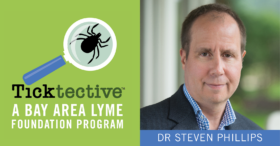
 Ticktective host, Dana Parish, talks with her longtime collaborator and co-author of